
Your real competition is the source set AI already uses.
AI Competition takes the sources extracted by AI Visibility and turns them into a practical benchmark. You compare your page against AI-selected sources, spot coverage and clarity gaps, and generate an explainable recommendations backlog that becomes draft-safe tasks.
Source set from AI Visibility runs.
Recommendations backlog + priorities.
Outline → draft → safe execution.
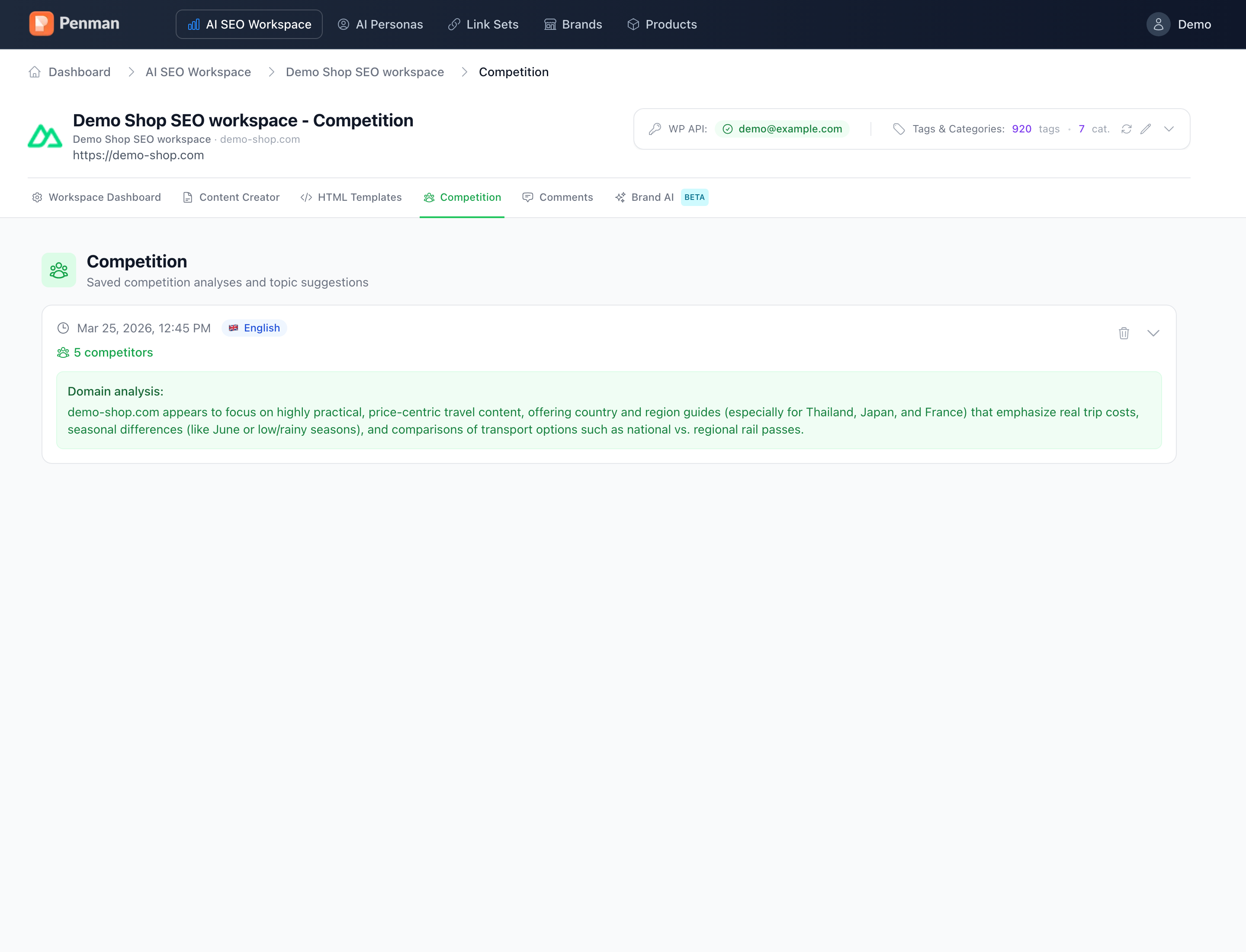
AI Visibility → AI Competition → recommendations backlog → draft-first execution.
Stop benchmarking against rankings — benchmark against what AI cites.
Generic competitor research doesn’t reflect what AI actually selects. PENMAN uses the source set from real AI outputs as the benchmark.
Instead of “Who ranks?”
Ask: “Who does AI cite or reference right now?” Rankings can lie; AI citations don’t.
Instead of “What should we write?”
Ask: “What gaps block AI selection vs the selected sources?” That’s the backlog.
Competition is a pipeline, not a tool view.
Convert the source set into an explainable, prioritized plan you can ship.
Import the AI-selected source set
Start with what AI already uses for your topic/intent. PENMAN pulls the sources from AI Visibility runs as the baseline.
Compare coverage and clarity
PENMAN compares your page with the selected sources to identify missing sections, unclear definitions, weak intent coverage and structural gaps.
topics, subtopics, FAQs
definitions, structure, context
Generate explainable recommendations
Gaps become recommendations with clear rationale: what to change, where to change it and how it connects to the AI-selected sources.
Prioritize what to ship first
The backlog is prioritized so teams ship small, verifiable batches: high-impact fixes first, then deeper improvements.
Hand off to outline → draft → safe execution
Recommendations become a structured outline and then WordPress drafts. Publishing is always explicit, with diffs and rollback.
Apply, schedule, or skip — always your call.
Each recommendation has a clear reason and a clear action. Apply to the WordPress draft, schedule for review, or skip with one tap.
- Heading restructure suggestions (H1–H6 hierarchy)
- Sections to add for missing entities and questions
- Internal-link insertions from your Link Sets
- Image alt & schema tweaks for AEO readiness
A bridge between visibility and publishing.
Competition produces a plan that’s ready to become drafts.
Prioritized backlog
Clear tasks grouped by impact and effort — ready to ship weekly.
Content outline
Structure aligned to intent coverage and AI-readable clarity.
Draft-ready changes
Improvements staged as drafts, ready for diff review and approval.
Turn the source set into a backlog you can ship.
Run AI Visibility, compare against AI-selected sources, generate recommendations, then execute as drafts with diffs and rollback.