
AEO & GEO for every client — without the chaos.
PENMAN gives SEO and content agencies one place to audit, brief, generate and publish for every WordPress site you manage — while keeping each brand’s voice perfectly distinct, and every change reviewable as a draft.
Be selected as a source.
Measure → compare → ship.
Drafts + diffs + rollback.
Discovery is becoming “answer-first.”
Clients still want growth, but the surface where their brand is remembered is shifting from blue links to AI answers.
Gartner predicts traditional search volume will drop 25% by 2026 as users shift to AI chatbots and assistants.
Bain reports ~80% of consumers rely on zero-click results for at least 40% of searches — cutting organic traffic 15–25%.
Adobe reported AI-driven referrals grew more than tenfold (Jul 2024 → Feb 2025), proving AI is a discovery channel.
What this means for your agency
- Clients will start asking “does AI mention us?” — you need a reportable answer.
- Winning move is operational: measure source selection, close gaps, ship safely — every cycle.
- Editorial safety matters: drafts-only publishing keeps client trust intact.
Treating AI visibility as “SEO.” AI answers are selections, not rankings. PENMAN focuses on selection signals + a controlled execution loop.
Faster delivery, sharper voice, safer publishing.
Built for the realities of multi-client work: separate brands, isolated voices, predictable approvals.
Many workspaces, one platform
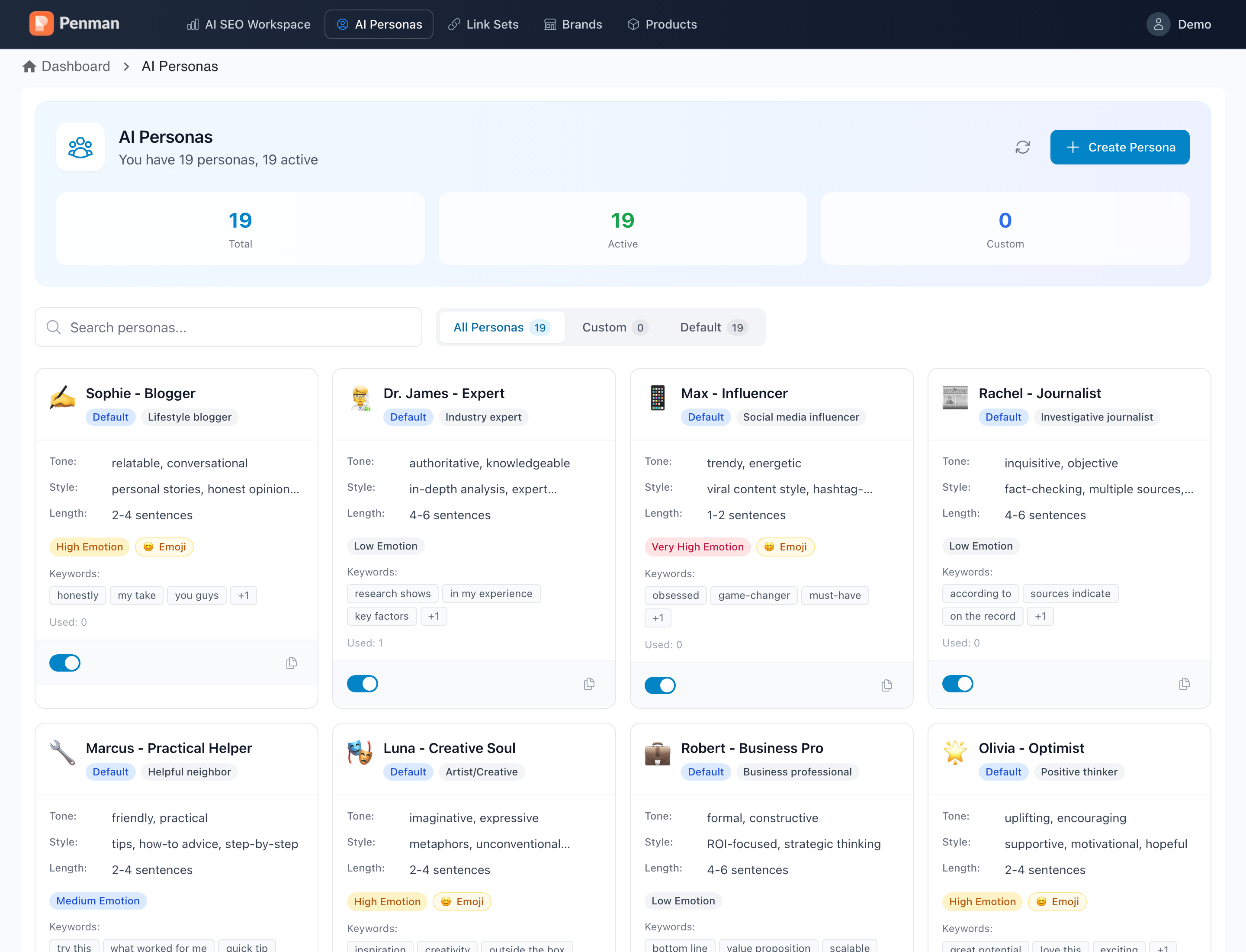
A workspace per client blog with isolated Brands, Personas and Link Sets. Switch context in one click — no “wrong client tone” mistakes.
Brand voice that survives scale
Personas + Brand context keep tone, USPs and forbidden phrases locked — even when shipping 30 articles a week across 12 clients.
Drafts-only by default
Nothing auto-publishes. Every change lands as a WordPress draft, ready for client review — reversible by design.
Audit → strategy → ship → report.
-
1
Connect each client blog
Workspace per client. Run AI Visibility + AI Competition audit on priority pages.
-
2
Define Brand & Personas
Lock voice, USPs, Products and Link Sets. Reuse across all generations.
-
3
Generate & brief
Outline + article in one flow, with internal links and HTML Templates.
-
4
Publish to WP as drafts
Client reviews & approves. Sync status keeps everyone honest.
-
5
Re-run & report
Show movement: AI Visibility deltas, source-set coverage, draft history. A monthly “AI visibility sprint” per client.
Everything an agency actually ships.
AI Visibility audits
Show clients which pages AI selects today, with relevance tiers. Repeatable per cycle.
AI Competition + recommendations
Compare against the source set AI prefers, then convert “why them?” into explainable backlog tasks.
Personas & Brand context
Lock tone, vocabulary and Products. AI quotes only what the client approved — no hallucinated features.
HTML Templates
Define the format contract once, generate hundreds of consistent posts. AI-suggested or hand-written rules.
Semantic internal linking
Strengthen topical clusters across each client site — faster than spreadsheets, safer than “random” auto-linkers.
Drafts · diffs · rollback
Apply changes as drafts, review diffs, publish explicitly, roll back safely. Client approvals stay clean.
Repeatable AI visibility — without editorial risk.
The strongest agency advantage is speed with control: ship improvements every cycle, keep diffs reviewable and never publish silently.
- Faster approvals: clients inspect diffs, not entire articles.
- Safer iterations: rollback when a change isn’t worth keeping.
- Cleaner operations: every cycle becomes a monthly “AI visibility sprint” per client.
Pick 1–3 pilot clients, 10–30 priority pages each.
Money pages, evergreen explainers, category hubs. Run AI Visibility, compare to AI-selected sources, ship draft-safe improvements, re-run next cycle.
One platform. Many client brands. Zero accidental publishes.
Measure AI visibility, compare to preferred sources, ship as drafts and report deltas. Built for retainer-grade work.